



What Makes a Good Dog Daycare? It Is Not the Facility.
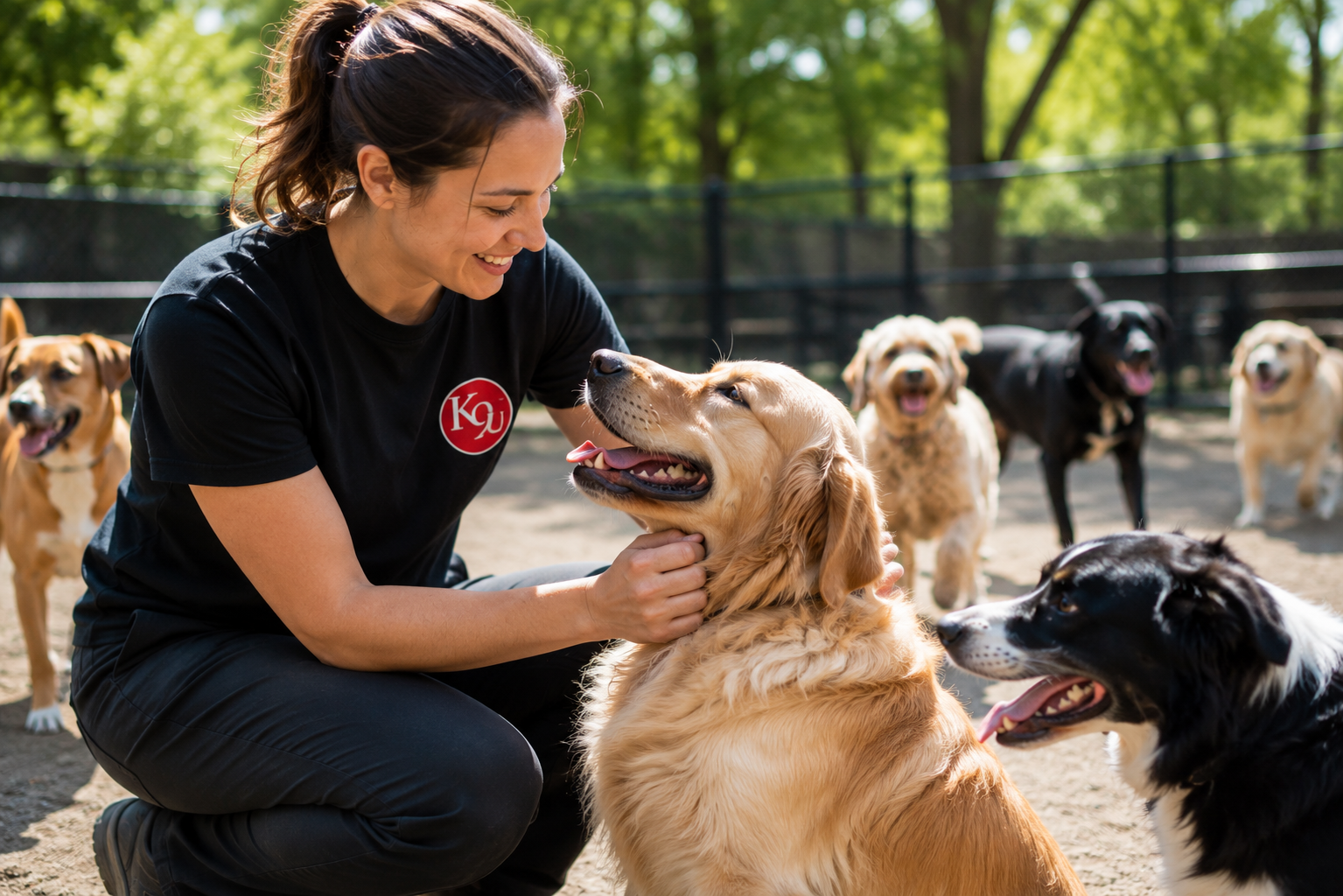
More than 30 years in business and 613 reviews later, here is what the data says.
We pulled our reviews recently. Six hundred and thirteen of them, written over a decade. The patterns were not what you would expect.
Customers do not review our square footage. They do not write about the indoor turf, the climate control, or the play yard layout we spent so much money planning. What they write about is people. More than 150 reviews mention specific team members by name: Jonathan, Sandra, Pablo, Cassie, and others. Some of our clients know our trainers better than they know their neighbors.
That data point reframed how we think about our business. The team is the product. The facility is just where the team works.
If you operate a daycare, boarding facility, training program, or grooming shop, the most important strategic question is not “what do dogs need from a space?” It is “what kind of workplace produces people who can deliver that care?”
Here is what we have found.
Continuity Is the Whole Game
A reactive dog who has built trust with a specific handler over weeks of careful work does not reset when that handler quits. The dog regresses. The owner notices. The trust we spent weeks building can evaporate in a single bad pickup.
Turnover in pet care is widely reported as high across the industry. At K9U, every staff departure is a behavioral plan rebuilt from scratch, a relationship a dog has to form again, institutional knowledge walking out the door.
So we invest in retention the way other businesses invest in marketing. Wages, advancement, professional development, real benefits. The math works because the alternative, a constant retraining loop, is more expensive than most operators realize until they sit down and total it up.
Staff Are Professionals
The reactive-dog success stories that fill our reviews did not happen because of a clever protocol. They happened because the people on our team have built real expertise in canine behavior, handling, and reading body language, and they keep building it.
That expertise has to be cultivated. We invest in our team’s professional growth so they can do harder work, better. The investment shows up nowhere on a daily P&L and everywhere in our reviews.
One of our families tells that story better than we can.
If you have ever wondered why some dog care facilities turn away anxious or reactive dogs, the honest answer is that handling those dogs well takes a level of skill most operators have not invested in developing. The bottleneck is the human training pipeline, and the dogs are paying for it.
Staff Need Permission to Advocate for the Dogs
This one took us a while to learn.
Early on, we treated certain decisions as managerial: which dogs go in which group, when a dog needs a break, whether to push or pause on a behavior goal. The people closest to the dogs had to escalate everything. The model produced worse outcomes than letting handlers make calls in real time.
Now, anyone on the floor can pull a dog from a dog daycare group without asking. They can flag a behavior concern without worrying about whether it makes the schedule harder. They can call an owner about a tough day without waiting for approval.
Psychological safety in this work is the precondition for honest assessment, and honest assessment is the precondition for behavioral progress. Treat it as a luxury and you get the opposite: a team performing safety theater because they are worried about scheduling pressure or making managers unhappy. That is not safety. That is liability with good lighting.
Your Culture Is Your Product
The hardest part of running a service business is that your culture is your product. There is no version of K9U that delivers behavior-forward care to anxious or reactive dogs without a team that is well-trained, well-treated, and aligned on what we are trying to do. Customers can feel the difference within weeks.
That is how the model works. Culture has to be maintained continuously, with the same discipline you maintain a play yard. You do not build it once and walk away.
For Other Operators Reading This
If you are running a dog care business and your churn is high, your customers are reviewing your facility instead of your people, and your operating costs feel out of control, those three things are connected. Fixing one without the others will not move the needle.
The owners who keep referring their dogs to us, year after year, are loyal to a team they trust with a family member, not to a building. You can read that loyalty in their own words on our testimonials page. That trust gets built one shift at a time, by people who feel respected by their employer and equipped to do real work.
So when someone asks what makes a great dog care center, my honest answer is: it is the workplace, not the worksite. Build the workplace right, and the rest follows. Get the workplace wrong, and no amount of marketing copy or facility upgrades will paper over what your clients can already feel.
If you are in the pet care industry and thinking about how to build a team that lasts, I would like to hear what is working for you. Drop a comment. This is a conversation worth having. If you are a Chicago dog owner curious about how this approach plays out in practice, learn more about our team and programs.


 Free Training Evaluation